
As we all know, turkeys are a national dish in the United States every Thanksgiving. No wonder, a lot of local farmers are interested in raising them for profit.
Although turkeys are much bigger than chickens, they have almost the same behavior when it comes to mating and having offspring. Yet, turkeys have some unique traits that you should know.
The actual mating of turkeys starts with the tom hopping on top of the hen while she is in a crouching position. Both sexes have cloacas, which is the opening near their tails and lead to their reproductive organs. This is also where the transfer of male sperm to the hen is done. This process is also called the cloacal kiss.
Generally speaking, turkeys are gentle, docile, and friendly to humans. When done properly, raising turkeys can also be a profitable business.
If you are an aspiring turkey breeder, this article will teach you everything about turkey mating behaviors. It also has some exciting facts about the relationship between turkeys, chickens, and peacocks.
Quick Answer: How Do Turkeys Mate?
- Courtship comes first: a tom struts, fans his tail, drums, and gobbles while his snood, wattle, and head caruncles flush bright red and engorge to win over hens.
- The act itself is a “cloacal kiss”: the tom mounts the crouching hen and presses his cloaca to hers to transfer sperm. Turkeys have no penis (unlike ducks), and the testes stay inside the body, near the kidneys.
- Breeding runs in spring, switched on by lengthening daylight. Toms are polygamous, and one tom can fertilize roughly 10 hens.
- A hen stores sperm in her oviduct for weeks (commonly 6 to 8), so a single mating can fertilize a whole clutch; eggs then hatch in about 28 days.
- Heritage breeds mate naturally, but commercial broad-breasted turkeys are too heavy-chested to mount and are bred almost entirely by artificial insemination.
Turkey Mating: Key Facts at a Glance
| Question | Answer |
|---|---|
| Who starts it? | The tom struts, fans his tail, drums, and gobbles while his snood, wattle, and caruncles flush red and swell. |
| How sperm transfers | A brief “cloacal kiss”: turkeys have no penis, so the tom presses his cloaca against the crouching hen’s. |
| Breeding season | Spring, triggered by longer daylight (about February to March in the south, April in the north). |
| One tom, many hens? | Yes. Toms are polygamous; a single dominant tom can fertilize around 10 hens. |
| Sperm storage | The hen stores sperm for weeks (often 6 to 8, sometimes up to about 16), fertilizing a whole clutch from one mating. |
| Incubation | About 28 days of brooding before the poults hatch. |
| Natural mating? | Heritage breeds mate naturally; broad-breasted commercial turkeys are too heavy and are bred by artificial insemination. |
Do Turkeys Mate for Life?
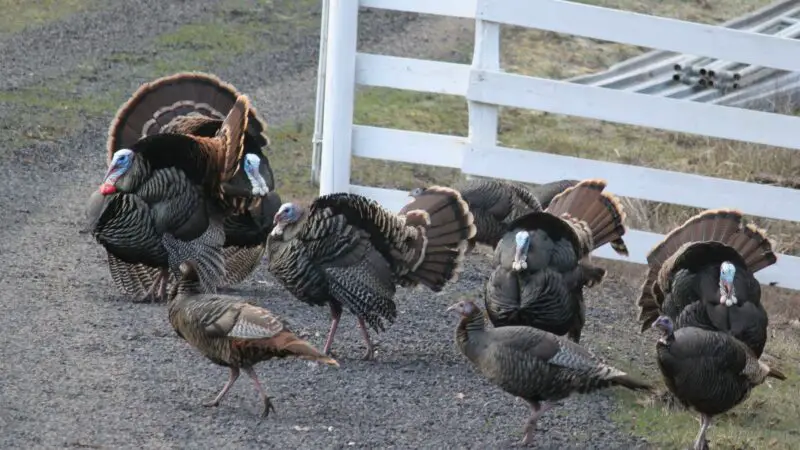
Turkeys don’t mate for life. These fowls are generally polygamous, which means that both sexes are not loyal and will mate with as many partners as they like.
In fact, toms (male turkeys) can mate with up to 10 hens (female turkeys) within the same mating season. This mating trait is very common in both wild turkeys and domesticated turkeys.
How Long Does It Take for Turkeys to Mate?
The copulation or actual mating of turkeys takes about 4 minutes or less, and the hen will then rest. Sometimes, the same couple will mate multiple times in just one sitting.
If there are a lot of hens around, the mating process may last for only less than a minute, and toms will mate with another hen. Most male turkeys start to mate at 7 months old.
What Time of the Year Do Turkeys Mate?
The season that turkeys mostly mate is spring. However, the months vary depending on where they are.
Turkeys in the northern states usually mate in April, while those in the southern states usually mate in late February or early March. Nonetheless, the exact time of the year when turkeys do mate mainly depends on the breed and location.
What Time of Day Do Turkeys Mate?
Turkeys usually mate in the morning just before sunrise during their mating season. It starts with the toms gobbling aloud to seduce the hens.
Once the females arrive, the male turkeys will perform the so-called “courtship dance.” Sometimes, younger turkeys help the older ones in courting. Once a hen gets interested, she will lower her back.
How Often Do Turkeys Mate?
Turkeys mate as long as they want, but not all of them. Just like in chickens, turkeys also have a social hierarchy among males called the pecking order.
Here, each turkey has a rank, and the tougher ones are in the higher rank. They can mate with as many hens as they want, while the weak ones cannot mate unless the dominant ones allow them to.
How Does a Male Turkey Fertilize Eggs?
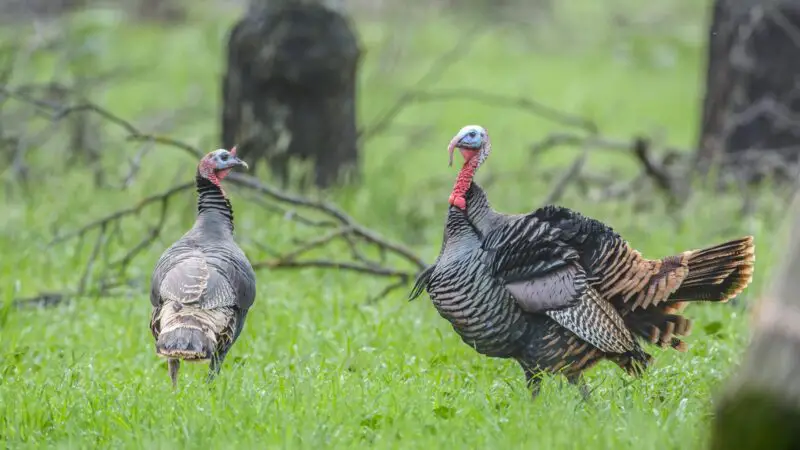
A male turkey can fertilize eggs only by mating with the females or copulating. Here, male turkeys transfer their sperm inside the female’s body through their cloacas.
But then, commercial broad-breasted turkeys are so heavy-chested that the toms physically cannot mount a hen, so essentially all of them are bred by artificial insemination. Heritage breeds, which are lighter and more athletic, still mate naturally the way wild turkeys do.
Do Turkeys Sit On Their Eggs at Night?
Turkeys sit on their eggs at night especially when they go broody. Broodiness is a natural behavior of wanting to have offspring.
Broody turkeys will tend to sit on their eggs almost 24 hours a day until the eggs hatch. It usually takes 28 days for turkey eggs to hatch. However, a turkey will only start to sit on eggs once all of them are laid.
When Do Wild Turkeys Mate?
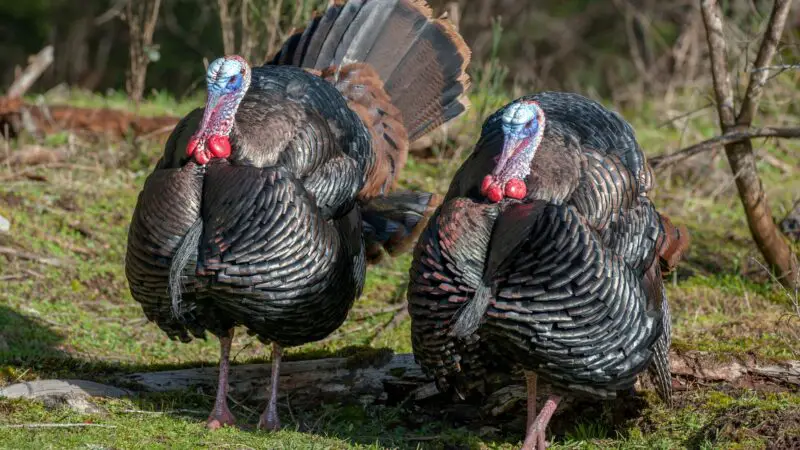
Domestic turkeys were bred from wild turkeys, so heritage breeds still share their spring mating behavior (broad-breasted commercial birds are the exception, since they cannot mate on their own). Hence, turkeys in the wild have the same mating period as domesticated ones.
They also mate from the late spring to early summer, depending on the breed and their location. For instance, Osceola wild turkeys start to mate a bit earlier than Eastern wild turkeys.
Can Turkeys and Chickens Mate?
Turkeys and chickens do not naturally interbreed. Even when their sperm and eggs are combined by artificial insemination, the offspring are almost never viable. Although both of them are members of the Phasianidae family, they belong to different species.
There have been previous attempts to cross between turkeys and chickens. Some of them produced fertilized eggs, and all of them eventually died.
According to a published report in 1960, sperms from Dark Cornish and Rhode Island Red cockerels were artificially inseminated into Bronze turkeys. The experiment resulted in 2,132 eggs, wherein 302 embryos were formed, and 23 of them were hybrid. The turkey-chicken (turkens) eggs were males, and 4 out of the 23 hybrid eggs hatched.
The said experiment showed that Dark Cornish and Rhode Island cockerels can fertilize turkey eggs. Interestingly, the resulting turkey-chicken hybrids look like more chicks than poults (baby turkeys). Sad to say, they only lived for about 20 weeks. Meanwhile, Transylvanian Naked Neck chickens are usually mistaken for turkens.
Can Peacocks and Turkeys Mate?
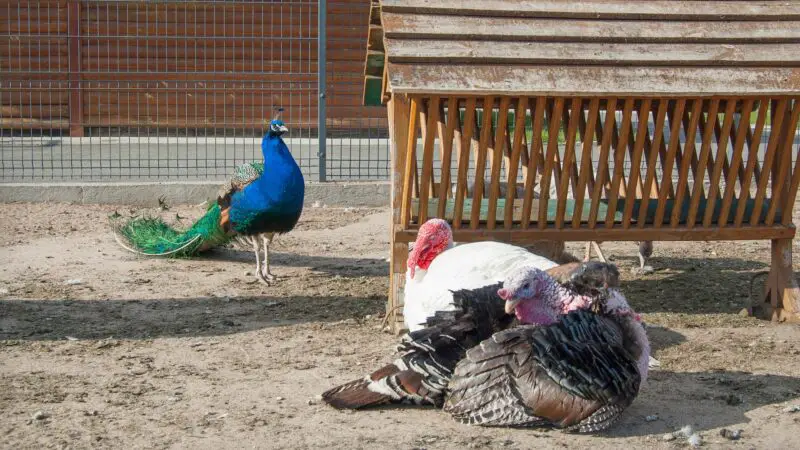
Peacocks and turkeys cannot mate simply because they belong to different species. Despite having some physical similarities, these two fowls have different chromosomes and are not even closely related to each other. If you found some photos of so-called gorgeous turkey peacock hybrids, they are only products of creative imaginations.
On the other hand, ocellated turkeys are a species that look like peacocks. Scientifically known as Meleagris ocellata, the ocellated turkey has a colorful mixture of bronze and green iridescent feathers. This peacock look-alike turkey breed is endemic to the Yucatan Peninsula in Mexico and is smaller and lighter than wild turkeys in the US.
Do Turkeys Have Balls?
Turkeys have balls or testicles that are shaped like beans. But instead of being visible outside, turkey testicles are inside the abdominal cavity, behind its wings, and just above the kidneys.
In fact, a turkey’s balls are edible and tastier than Rocky Mountain oysters. There are also Turkey Testicle Festivals in some parts of the US.
Can a Turkey Impregnate Itself?
A female turkey can impregnate itself but not always. It means that the embryo in their eggs will develop without fertilization or male sperm.
This process of reproducing asexually is called parthenogenesis, which can also happen in some animals, such as birds, chickens, and lizards. Nonetheless, this phenomenon is not possible in mammals.
Turkey parthenogenesis has actually been studied for decades. USDA researchers documented it across tens of thousands of eggs from unmated Beltsville Small White hens, though exactly what triggers it is still not fully understood. Also sometimes called “virgin birth,” parthenogenesis in turkeys usually results in males.
But in some insects, including bees and wasps, the offspring can be males only, females only, or both sexes. Asexual reproduction is not common in birds, though.
Related Turkey Keeping Guides
Raising turkeys? Here are more turkey keeping guides worth reading:
- Turkey Breeds: Visual ID Guide
- Turkey Chick Care
- Are Turkeys Hard to Raise?
- How Turkeys Survive Winter
- Best Housing for Turkeys
List of Sources
Turkey Mating Season – https://www.housing.wisc.edu/2021/04/turkeys/
Turkey Time – https://ucanr.edu/blogs/blogcore/postdetail.cfm?postnum=55633
Wild Turkey – http://www.biokids.umich.edu/critters/Meleagris_gallopavo/
Modern Turkey Industry – https://extension.psu.edu/modern-turkey-industry